
Watertown City Directory Collections at Flower
Roswell P. Flower Memorial Library is the main Watertown shelf for historic directory work. Its digitized collection, hosted by New York Heritage, has 33 nonconsecutive Watertown volumes dated 1855 through 1916. The collection description confirms resident, business, and local-government sections, with street-by-street listings in later volumes. Flower's Reference area holds additional years that were not included in the digital run, so an online gap is a reason to check the library rather than an answer in itself.
| Collection | Years or extent | Where held | Access route |
|---|---|---|---|
| Digitized Watertown directories | 33 nonconsecutive volumes, 1855-1916 | Flower Memorial Library and New York Heritage | Free collection search |
| Additional Watertown directory volumes | Years not fully published | Flower Reference area | Use in person during library hours |
| Address conversion volume | 1908 | Flower and New York Heritage | Consult the street section for old and current numbers |
| Selected subscription copies | Coverage varies | Flower Memorial Library | Use in-library Ancestry access |
The New York Heritage collection is the quickest first stop for a dated name or street question. For a missing year, Flower says the physical collection can be used whenever the library is open. A library visit also allows a reader to compare the title page, the local headings, and the abbreviation key before drawing conclusions from one name line.
Note: The digital set is intentionally described as nonconsecutive, so its first and last dates do not establish uninterrupted annual coverage.
Watertown's 1907 Reset in City Directory Searches
Watertown changed its address structure in 1907 because the older numbers left too little room for new buildings. That local change is the key quirk in a historical address search. Flower's Buildings and Homes guidance directs researchers to the 1908 volume when they need to cross the divide. In its street section, the contemporary number appears in brackets beside the former number.
Use that printed bridge before sending a present address into a pre-1908 volume. A modern parcel location can identify the land, but it does not convert the old number by itself. Once the 1908 crosswalk supplies the earlier number, check the street listing and then use the surname found there in the name portion of the earlier directory. This is more reliable than guessing from a map or assuming a house kept the same number.
Address clue. Flower's Buildings and Homes in Watertown guide makes the 1908 street section the documented bridge between the old and current numbering systems.
How to Read a Watertown City Directory Entry
Watertown editions have a name-oriented half and a street-address half, but the digitized viewer was not available for a page-level transcription during the research. That means a reader should not promise a uniform entry format across every edition. Begin with the volume's own key and headings, then record exactly what that edition prints. The confirmed collection-level evidence supports names, businesses, local-government material, and later street lists, not a fixed set of personal details on every line.
| Name section | Use it to locate a surname or business and note the spelling and initials used in that particular volume. |
|---|---|
| Street section | Later Watertown volumes include listings by street; the 1908 section also supplies the old and current number bridge. |
| Headings | Read the local column labels before treating a number, initial, or abbreviation as a personal fact. |
| Abbreviation key | Check the key in the same volume, since the research did not verify one universal Watertown key. |
- Street section
- The address-ordered part of a volume. In later Watertown directories it can connect an address to a listed name or business.
- Householder index
- A name arrangement used to locate a person or household heading before comparing it with the address portion.
- Abbreviation key
- The volume's explanation of its shortened labels. Read it first instead of carrying an interpretation from another year.
Watertown City Directory Research at Flower's Desk
Flower's genealogy department offers several ways to move beyond a digital search. Detailed questions can go by contact form, email, or postal mail with a self-addressed stamped envelope. A brief question can be asked by phone at 315-785-7711. The genealogy desk is open noon to 4 p.m. Monday through Saturday. Searches are free; copies cost 20 cents per page plus postage.
The library also supplies useful companion evidence. Its Family Files consist largely of volunteer-clipped obituaries, and its genealogy area has state vital-record index microfiche, in-library Ancestry, city directories, and Watertown Daily Times and New York Times microfilm. The Daily Times online collection covers 1988 to the present with a library-card login, while earlier Daily Times issues are on microfilm. Those channels turn a directory appearance into a dated lead that can be checked, not a final identification.
Flower's genealogy department is the right contact for the directory and local-name shelf. The New York State Library listing also identifies Flower as a local repository for state vital-index microfiche, which can guide a lawful historical records request when the date rules are met.
Note: A library staff search can locate a source, while a copy request may still add postage after the per-page charge.
Tracing a Watertown Family Through City Directories
Use the historical volumes as a dated sequence. For a house question, first identify the property and its year built in the appropriate city record, then use the 1908 number bridge when the investigation crosses 1907. For a surname question, begin in the name section, compare each available year, and return to the street section when an address appears. Pair each candidate with the closest released federal census and with records that answer a separate question.
- Find the earliest available Watertown entry for the surname or the converted street number, and copy the spelling exactly as printed.
- Move through the available directory years, noting changes in initials, address, business listing, or a disappearance from the run.
- Use the street section to test whether the same address carries a related surname or business in that edition.
- Compare the result with the closest released federal census, then check deeds, a newspaper notice, or a vital-index lead for a second source.
- Use obituaries, probate material, church records, or yearbooks to resolve a move, death, marriage, or school-era connection where the dated evidence supports it.
A directory absence does not prove that someone left Watertown. The digitized run has gaps, spelling and initials can shift, and a person may be omitted under a listing convention that needs the volume's own key. For a current address-keyed record trail, use the separate Watertown streets resource rather than treating the historical shelf as a modern household list.
Watertown City Directory Clues in Newspapers and Yearbooks
A directory date can be expanded with Flower's house-history sources. The library points researchers to free New York State Historic Newspapers name and address searching, the Daily Times collections, Historic Homes of Watertown and Old Houses of the North Country, National Register address searches, Family Files, and deed work through the Jefferson County Clerk. Each source has a narrower role: a newspaper can date an event or mention a name, while a deed connects parties to a property transaction.
Watertown High School yearbooks from 1907 through 2010 are another locally held collection identified through New York Heritage. They can support a former classmate or family-history question in the appropriate era, but they are not address lists. Use the date, the printed name, and a second record before tying a yearbook image to a particular household.
Watertown Church Records Beyond the City Directory
Several Flower church-record guides reach before Watertown civil vital records. St. Patrick's includes baptisms from 1846 to 1880 and marriages from 1852 to 1906. Stone Street Presbyterian has a membership roll for 1831 to 1885 with marriage and death lists, while Trinity Episcopal has an 1853 family list and baptisms, marriages, and burials from 1846 to 1881. St. Paul's Episcopal adds a 1907 to 1915 membership roll with several event types.
These are useful companion records when a city directory identifies a likely family but no civil record is yet available. Index status differs by run, so record the denomination, date range, and record type rather than assuming every church book is fully indexed or complete. Flower's genealogy desk can direct a researcher to the relevant local guide.
Note: Church material can strengthen a dated family trail, but it should be matched to the exact congregation and period rather than generalized across Watertown.
Flower and Paddock Mansion: Two Watertown Research Stops
Flower and the Jefferson County Historical Society serve different parts of a local-history inquiry. Flower is the directory, name, microfilm, and genealogy starting point. The Historical Society, in the Paddock Mansion at 228 Washington Street, holds more than 100,000 artifacts and more than 15,000 Huested glass-plate negatives, along with letters, portraits, photographs, and other local material. It refers genealogy researchers back to Flower, which keeps the division of work clear.
The two institutions are one block apart, with Flower at 229 Washington Street. The Historical Society's summer hours are Thursday through Saturday, 10 a.m. to 4 p.m., with Wednesday visits by appointment. Its Paddock Mansion information is useful for visual or place context after Flower has supplied the directory lead.
The Historical Society's public collection source follows the directory collection image because it shows the complementary archival stop, not another directory index.
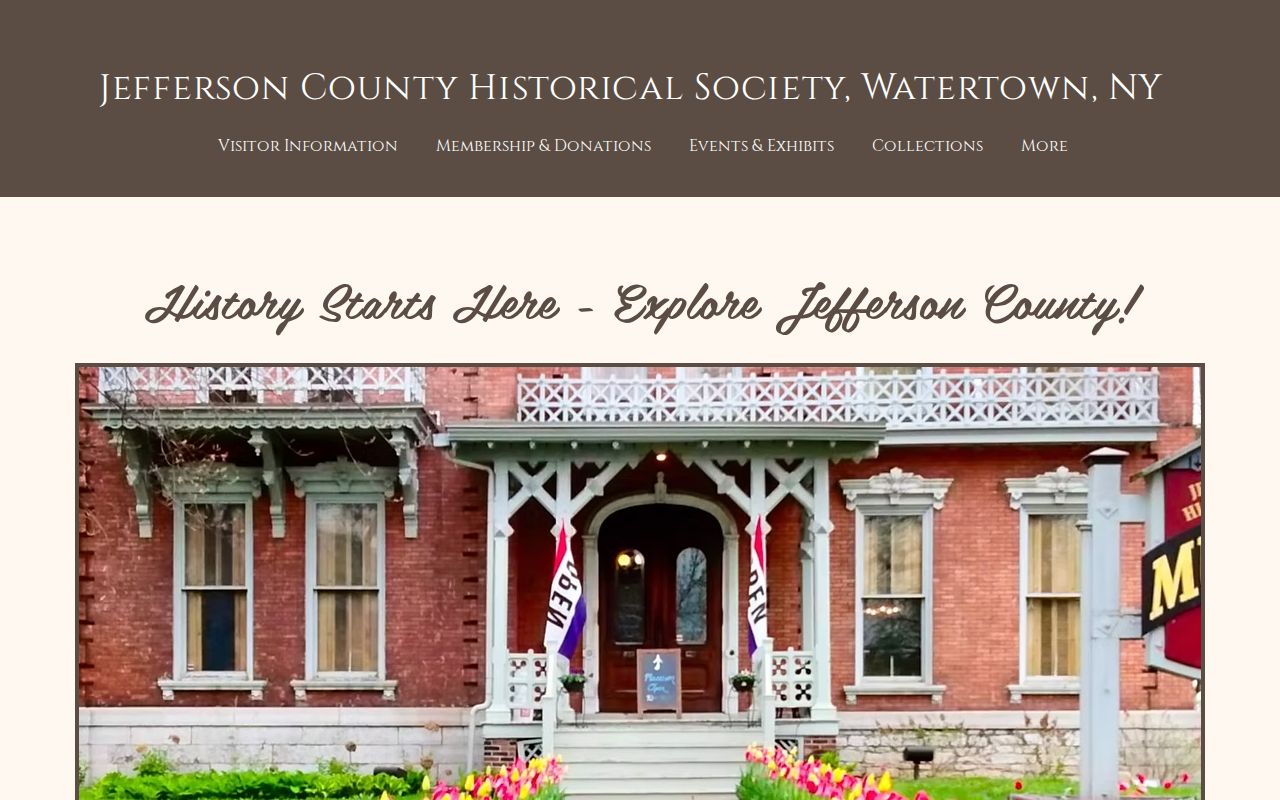
The Society's collections can add a photograph or local setting to a Watertown family-history trail, while Flower remains the documented place to begin a directory or genealogy search.
A Watertown City Directory Gap Needs a Second Source
When a name or address is not found, return to the source chain instead of treating the blank as a verdict. The 33 online volumes are nonconsecutive, Flower holds more physical material, and the 1907 change can put an earlier address under a different number. A different spelling, a changed initial, a business listing, or an omission may also explain the result. Compare a directory finding with a deed, newspaper, family file, church run, yearbook, or released census record appropriate to the date.
The digitized Watertown collection is shown here as the online entry point to that process.
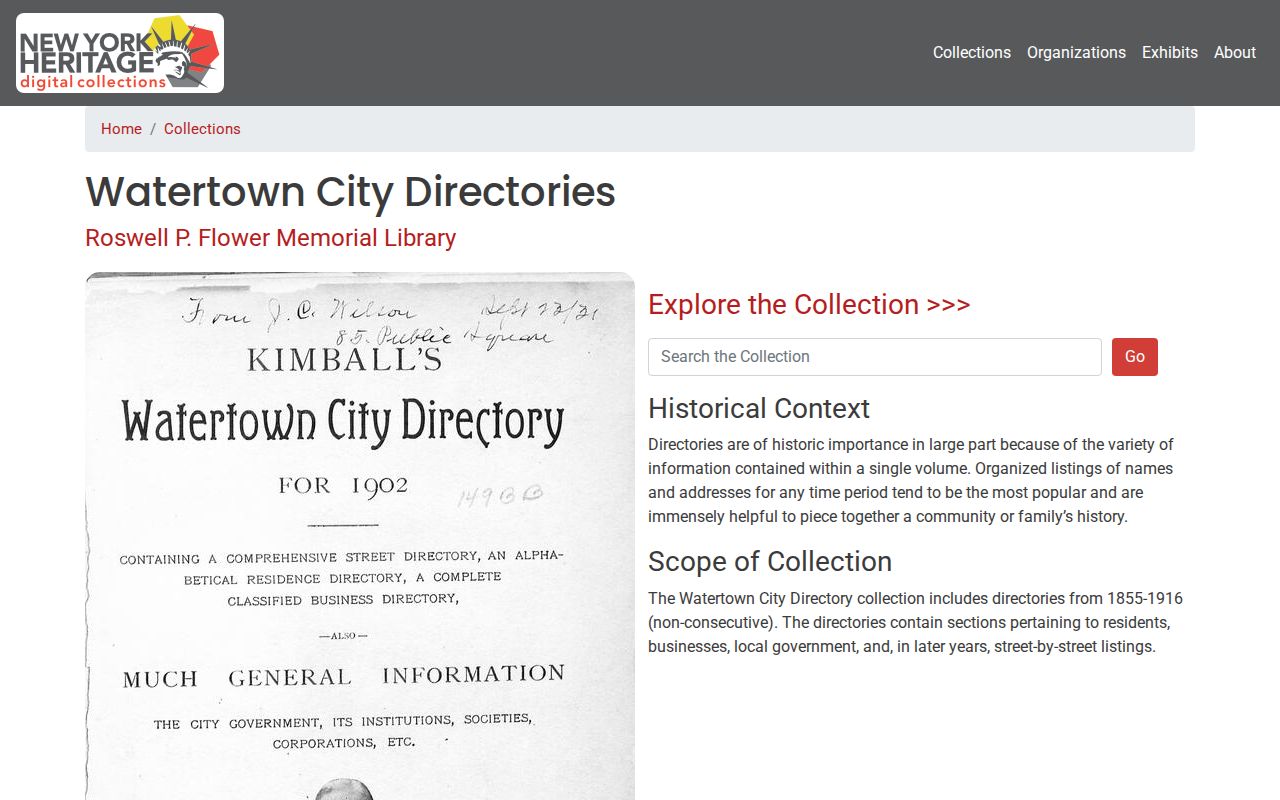
The collection search can surface a digitized volume quickly, but a complete Watertown inquiry may still require Flower's physical shelves, staff assistance, or a companion historical source.
Personal history only. Use historical names and addresses for family, local, or house-history research. Do not use them to stalk, harass, or harm any person.